
RunMat vs Physics AI
Physics AI is machine learning trained to predict what a simulation would return, in seconds, from earlier solutions or from the equations. RunMat is a solver: it computes the governing equations on your CAD geometry for each case and reports how close it got, and it uses AI to set the study up. The two work well together.
- Results computed from the equations, on your mesh
- Checked against closed-form answers and reference cases
- AI writes the study; RunMat checks it before it solves
Facts about Physics AI checked November 6, 2026. Sources
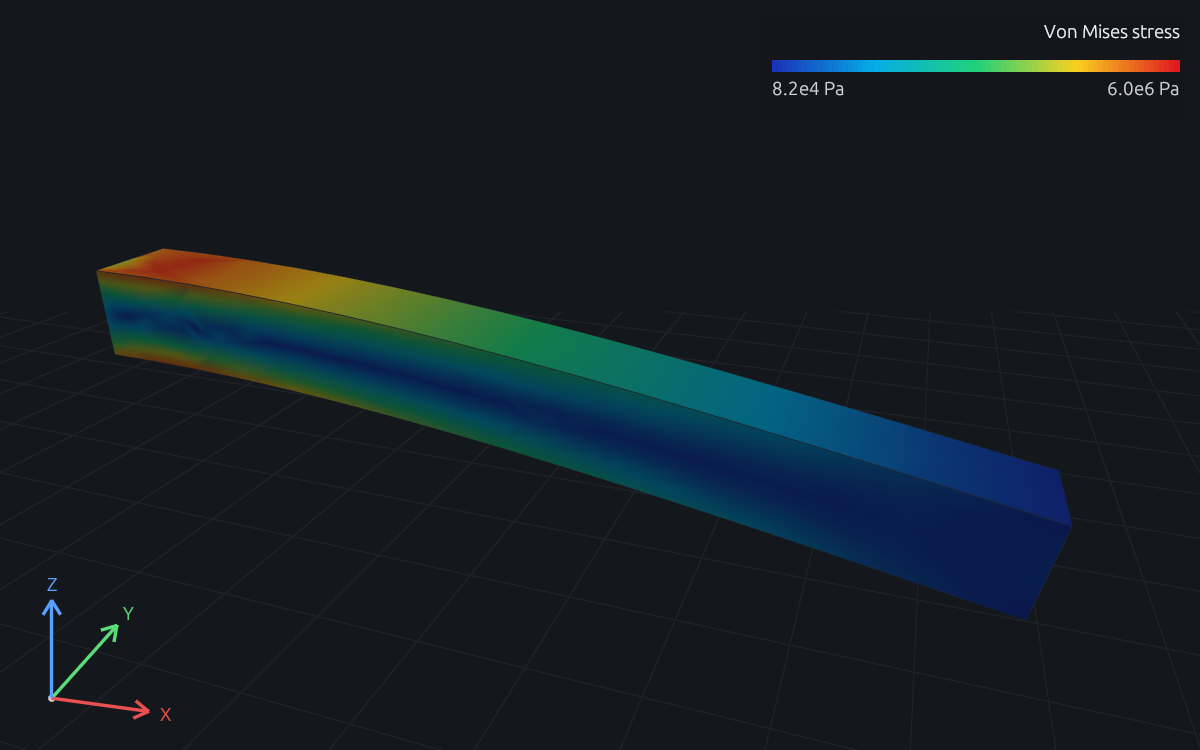
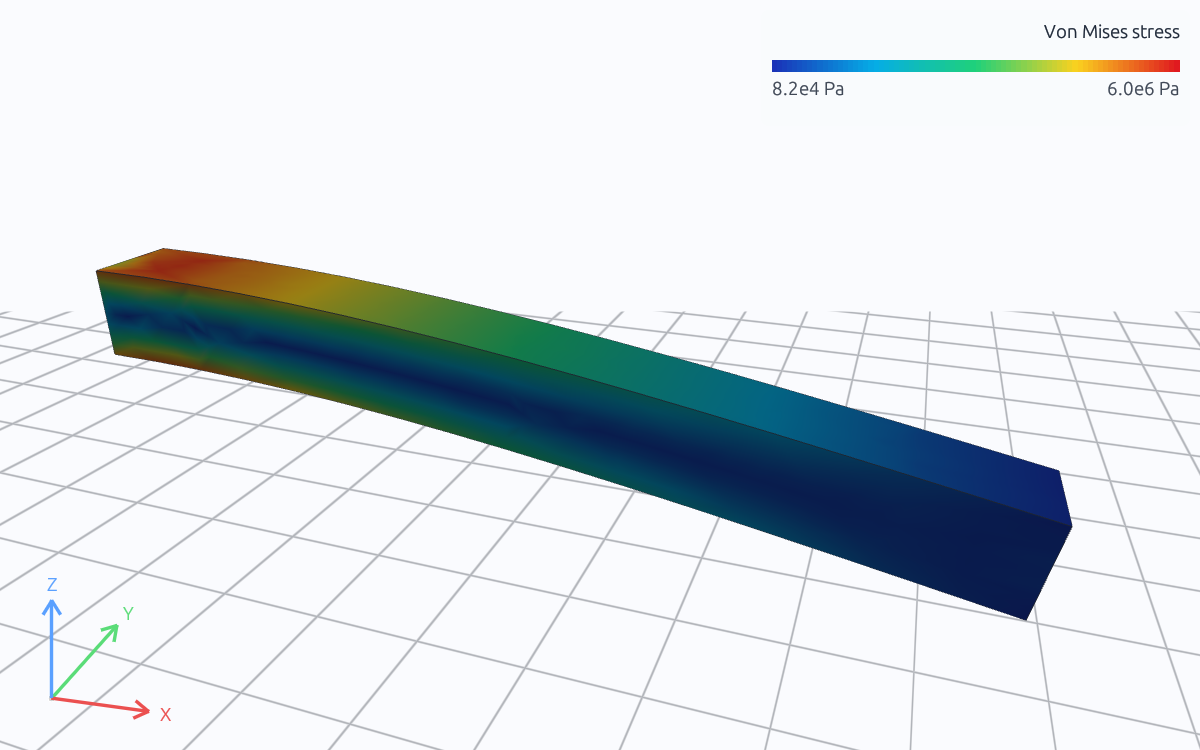
- Tip deflection
- 0.2000 mm (beam theory 0.2000 mm)
- Top-surface stress at x = 100 mm
- 5.43 MPa (beam theory 5.40 MPa)
What Physics AI is
Physics AI is machine learning trained to return the result of a physics simulation, such as a stress, flow or temperature field, without solving the equations again for each case. Three kinds come up most often.
Learned surrogates
- Trained on
- Tens to hundreds of earlier simulation results for one design family; one vendor cites 30 to 100 [2].
- Returns
- The predicted result for a new design in that family, in seconds.
- Good at
- Screening many variants that sit close to the training data.
- Weak at
- Designs unlike the training data, where accuracy falls. The vendor's model reports a confidence level to flag them [2].
Physics-informed neural networks (PINNs)
- Trained on
- The governing equations, written into the training loss as a penalty, plus any measured data [1].
- Returns
- One solution field per training run.
- Good at
- Inverse problems and sparse measurements, where data and equations are combined [1].
- Weak at
- Training is hard to optimize, and standard PINNs fail on some simple convection and reaction problems [4]. Equations and boundary conditions hold only approximately.
Neural operators
- Trained on
- Many solved input and output pairs for one family of equations. Fourier neural operators and DeepONet are the best-known designs [3][6].
- Returns
- A mapping from inputs, such as a coefficient field, to the solution field. The FNO paper reports up to three orders of magnitude faster than traditional solvers on its benchmarks [3].
- Good at
- Repeated solves of one equation family with changing inputs.
- Weak at
- Inputs outside the training distribution. Accuracy is measured on average over a test set, not for the case in front of you.
All three are fitted to data a solver usually produced, and each one's error is known on average over its test cases. For the next design it is an estimate. A 2024 review found that 60 of 76 papers claiming machine learning beat a numerical method for fluid equations compared against a weak baseline [5].
What RunMat is
RunMat is a finite element solver. For each study it meshes your CAD geometry and solves the governing equations, such as equilibrium, heat conduction or Maxwell's equations, for the materials, supports and loads written in the study. A new design is solved the same way as the last one, and the error is driven down by refining the mesh and checked against closed-form answers and reference cases.
AI in RunMat sets up the study. Guided setup, or Claude Code, Codex and other MCP clients, asks about the part and writes the .fea file; RunMat checks units, regions and the analysis chain before it meshes. Every number in the result comes from the solver.
How they fit together
They answer different questions. A surrogate answers "roughly what happens across this design family, right now"; a solve answers "what happens to this design". Teams that use both train the model on solver results and confirm its best candidates with a solve.
RunMat fits both ends of that loop. A MATLAB script sweeps a study over loads and dimensions, in parallel, and collects each result with its inputs as training data. When the model proposes a design, the same study solves it before it goes into a report.
What each returns
"Physics AI" covers several methods. The two most common are learned surrogates, trained on earlier simulation results, and physics-informed neural networks (PINNs), trained to reduce the residual of the equations [1].
| Topic | RunMat | Physics AI |
|---|---|---|
| What you get | A solution of the governing equations on your mesh, for the geometry, materials and loads in the study. | Surrogates and neural operators: a prediction learned from solved examples [2][3]. PINNs: a network fitted to the equations as a penalty in its loss [1][4]. |
| Before the first answer | Geometry, materials, loads and supports. | Surrogates: earlier simulations of similar designs; one vendor cites 30 to 100 results to train a model [2]. PINNs: a training run per problem. |
| How you know it is right | Mesh convergence, energy balance and comparison with closed-form answers and reference cases. | Surrogates: a confidence estimate, which drops for designs far from the training data [2]. PINNs: the remaining loss, which can stay high on simple problems [4]. |
| A design unlike the training data | Solved the same way as any other. | Accuracy falls outside the range the model was trained on [2]; new data and retraining bring it back. |
| Speed | Seconds to hours per solve, set by the mesh size and the physics. | Seconds per prediction once trained, after the cost of generating training data and training [2]. |
| Boundary conditions and units | Enforced in the solve; units and regions checked before meshing. | Surrogates learn them from the data. PINNs usually apply them as soft penalties in the loss [4]. |
- What you get
- RunMatA solution of the governing equations on your mesh, for the geometry, materials and loads in the study.
- Physics AISurrogates and neural operators: a prediction learned from solved examples [2][3]. PINNs: a network fitted to the equations as a penalty in its loss [1][4].
- Before the first answer
- RunMatGeometry, materials, loads and supports.
- Physics AISurrogates: earlier simulations of similar designs; one vendor cites 30 to 100 results to train a model [2]. PINNs: a training run per problem.
- How you know it is right
- RunMatMesh convergence, energy balance and comparison with closed-form answers and reference cases.
- Physics AISurrogates: a confidence estimate, which drops for designs far from the training data [2]. PINNs: the remaining loss, which can stay high on simple problems [4].
- A design unlike the training data
- RunMatSolved the same way as any other.
- Physics AIAccuracy falls outside the range the model was trained on [2]; new data and retraining bring it back.
- Speed
- RunMatSeconds to hours per solve, set by the mesh size and the physics.
- Physics AISeconds per prediction once trained, after the cost of generating training data and training [2].
- Boundary conditions and units
- RunMatEnforced in the solve; units and regions checked before meshing.
- Physics AISurrogates learn them from the data. PINNs usually apply them as soft penalties in the loss [4].
Where AI helps in RunMat
RunMat puts the model where it is reliable, writing and reviewing the setup, and leaves the numbers to the solver.
Set up the study
- Describe the part and the loads
- The agent writes the study on your STEP file
- Every input listed as stated, derived or proposed
- Changes arrive as an edit you accept
Check before solving
- Units on every number
- Regions matched to the geometry
- The chain of analyses checked
- Errors sent back to the model with the line
Solve
- Structural, thermal and electromagnetic
- Acoustic and laminar flow
- Coupled thermal stress and Joule heating
- Laptop, servers or cluster
Generate training data
- Sweep loads and dimensions from a script
- Run hundreds of studies in parallel
- Collect result fields in one table
- Keep inputs and version with each run
Use the model you have
- Claude Code and Codex through MCP
- Any MCP client
- The built-in agent
- Your company's own model endpoint
Report
- Every number traced to a run
- Assessments against your limits
- Results reviewed live with your team
- Studies kept as text with the report
When RunMat is the better choice
A solve is the better choice whenever the number goes into a decision someone signs.
A design that has not been simulated before, or differs from the earlier ones in geometry, material or load path.
A result for a report, a review board or a customer, where each value needs its mesh, inputs and a reference check.
A new design family with no earlier results to learn from. A surrogate needs tens of solved cases before its first prediction [2].
Boundary conditions and supports that must hold exactly, not as a penalty in a loss.
Building the training data for a surrogate, or checking what one predicts.
When a learned model is the better choice
- Screening thousands of variants of a design family that solver runs already cover, before solving the shortlist.
- Real-time estimates in a digital twin or a control loop, where a solve per query takes too long.
- Inverse problems and data assimilation with sparse measurements, where PINNs combine data and equations [1].
- Interactive design tools where a quick estimate guides the engineer and a solve confirms the final design.
Simulation works with the rest of RunMat
- Runtime
With MATLAB code
Sweep a dimension or a load from a MATLAB script, solve every case across your cores and read the results back as arrays, beside your hand calculations.
- MCAD
With MCAD
Model the part in RunMat MCAD and the study reads it directly. Change a dimension and the study reruns on the new geometry, with its supports and loads still on the right faces.
- ECAD
With ECAD
Board temperature, IR drop and warpage solve on the board you laid out in RunMat ECAD, from its stackup, copper and the circuit's power, with no export step.
Use both
- 01
Solve the cases that matter
Set up the study in RunMat, check it against a closed-form answer or a reference case, and solve the designs you will sign off.
- 02
Sweep to build a dataset
Drive the study from a MATLAB script over loads and dimensions, in parallel, and collect the results with their inputs.
- 03
Confirm what the model predicts
Train a surrogate on the sweep if you need one, and solve its best candidates in RunMat before they go into a report.
What the research says
The cantilever on this page shows what a solve returns: a tip deflection of 0.2000 mm against 0.2000 mm from beam theory (0.02%), and a top-surface stress of 5.43 MPa against 5.40 MPa (0.61%). Each value comes with the mesh and build that produced it.
PINNs were introduced as networks trained on both data and the residual of the governing equations [1]. A NeurIPS 2021 study found that this soft penalty makes training hard to optimize, and that standard PINNs fail on simple convection and reaction problems [4].
A 2024 review in Nature Machine Intelligence found that 60 of 76 papers (79%) claiming that machine learning beat a numerical method for fluid-related equations compared against a weak baseline [5]. The baseline is the first thing to check in any Physics AI claim.
Vendors present their surrogates the same way: Ansys describes SimAI as learning from earlier simulation data and reporting a confidence level that flags designs too far from it [2].
License
RunMat is source-available under the Business Source License 1.1, and each version converts to the Apache License 2.0 three years after the date it is first published.
The source code is available on GitHub, so you can read, build and modify the code that produces every result. Enterprise adds self-hosted deployment, including fully offline, under contract.
Questions
01Can AI replace finite element simulation?
Not for a result you sign off. A learned model predicts from earlier solutions and is accurate inside the range it was trained on [2]. A solver computes the case in front of you and can be checked against closed-form answers. AI is most useful for setting up studies and for fast screening over solved data.
02What is a physics-informed neural network?
03What is a surrogate model?
A fast model trained on results from a solver or from tests, used to predict results for new inputs. Its accuracy depends on how close the new inputs are to the training data [2].
04Does RunMat use AI?
Yes, to set up and review studies. RunMat's agent, or Claude Code, Codex and other MCP clients, writes the study from a description; RunMat checks units, regions and the analysis chain, then solves it. Every number in the answer comes from the solver.
05How does RunMat show a result is right?
Each documented example records its result with the mesh, the build and a reference value, such as the beam-theory deflection of a cantilever. The validation pages list the reference cases each solver is checked against.
Sources
We checked the facts about Physics AI on this page against these sources on November 6, 2026.
- [1]Raissi, Perdikaris and Karniadakis, Physics-informed neural networks, Journal of Computational Physics 378 (2019) 686–707doi.org
- [2]Ansys, SimAIansys.com
- [3]Li et al., Fourier Neural Operator for Parametric Partial Differential Equations, ICLR 2021arxiv.org
- [4]Krishnapriyan et al., Characterizing possible failure modes in physics-informed neural networks, NeurIPS 2021arxiv.org
- [5]McGreivy and Hakim, Weak baselines and reporting biases lead to overoptimism in machine learning for fluid-related partial differential equations, Nature Machine Intelligence (2024)doi.org
- [6]Lu et al., Learning nonlinear operators via DeepONet, Nature Machine Intelligence 3 (2021)arxiv.org