
Predict pressure drop and flow through your parts and assemblies
Check that a manifold, channel or passage stays within its pressure-loss budget at rated flow. Import the STEP file, write the fluid, inlets, outlets and walls in a short text file, and RunMat solves it.
RunMat works with you to set up your studies
Go from a CAD file to a complete, runnable study in minutes.
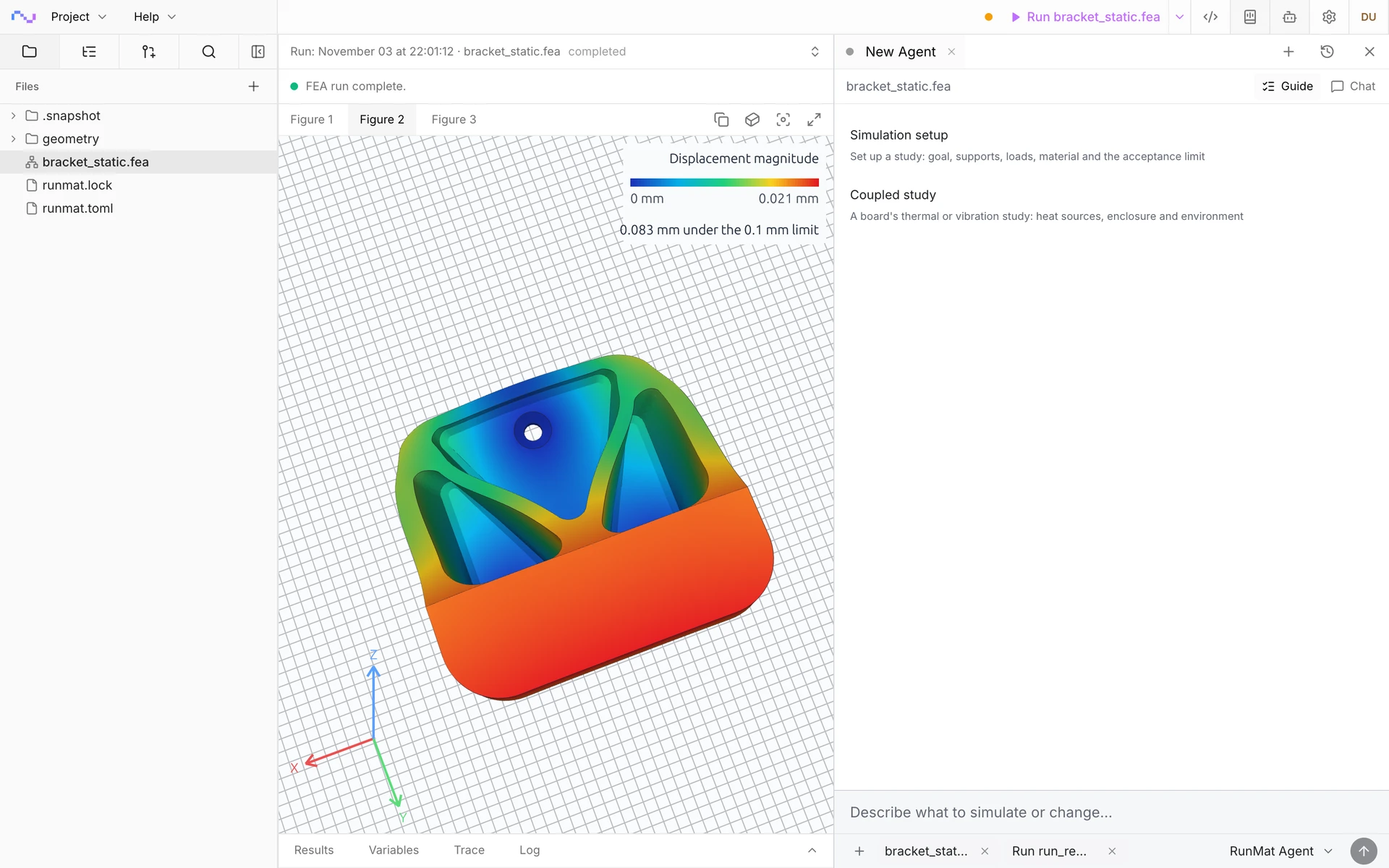
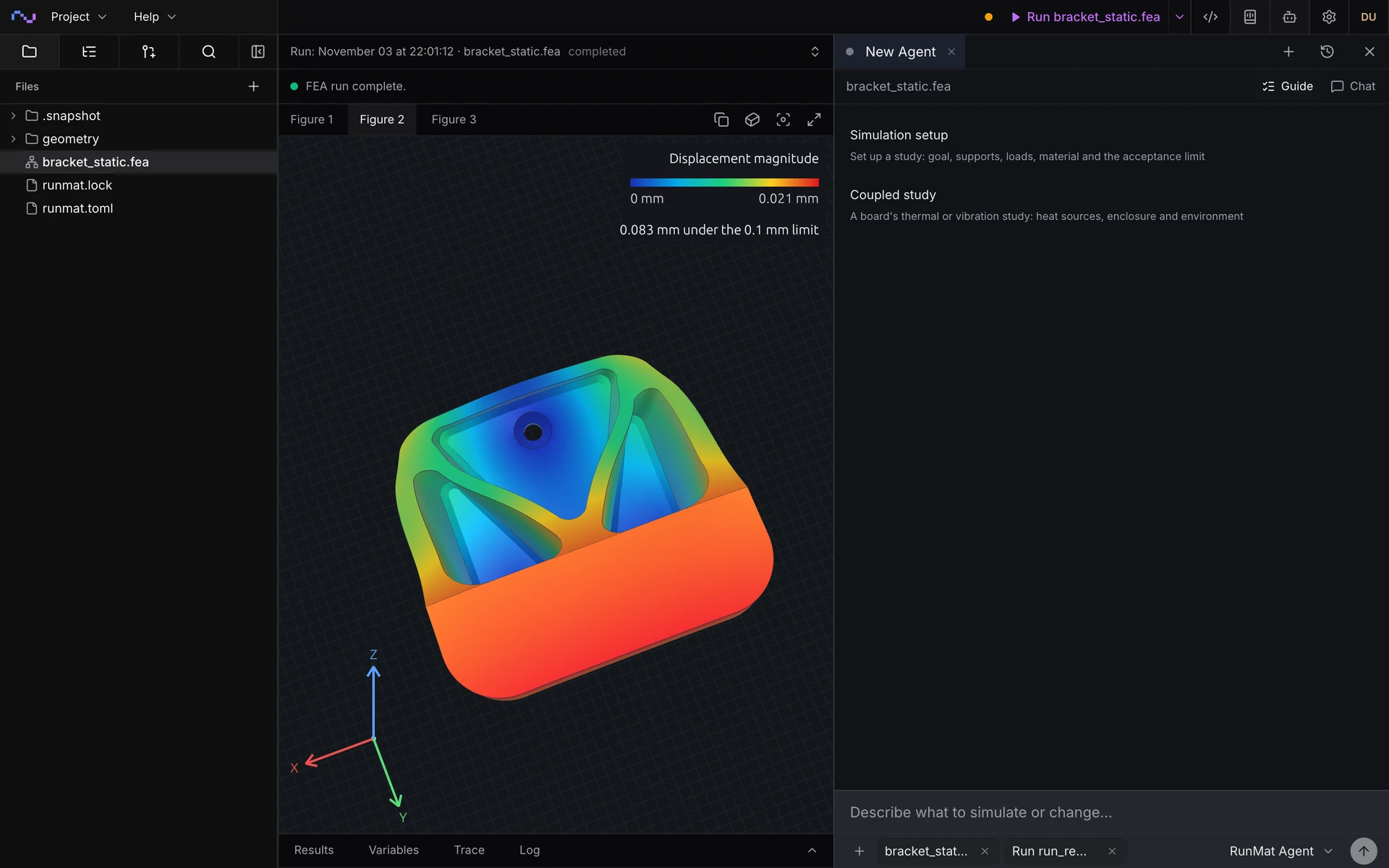
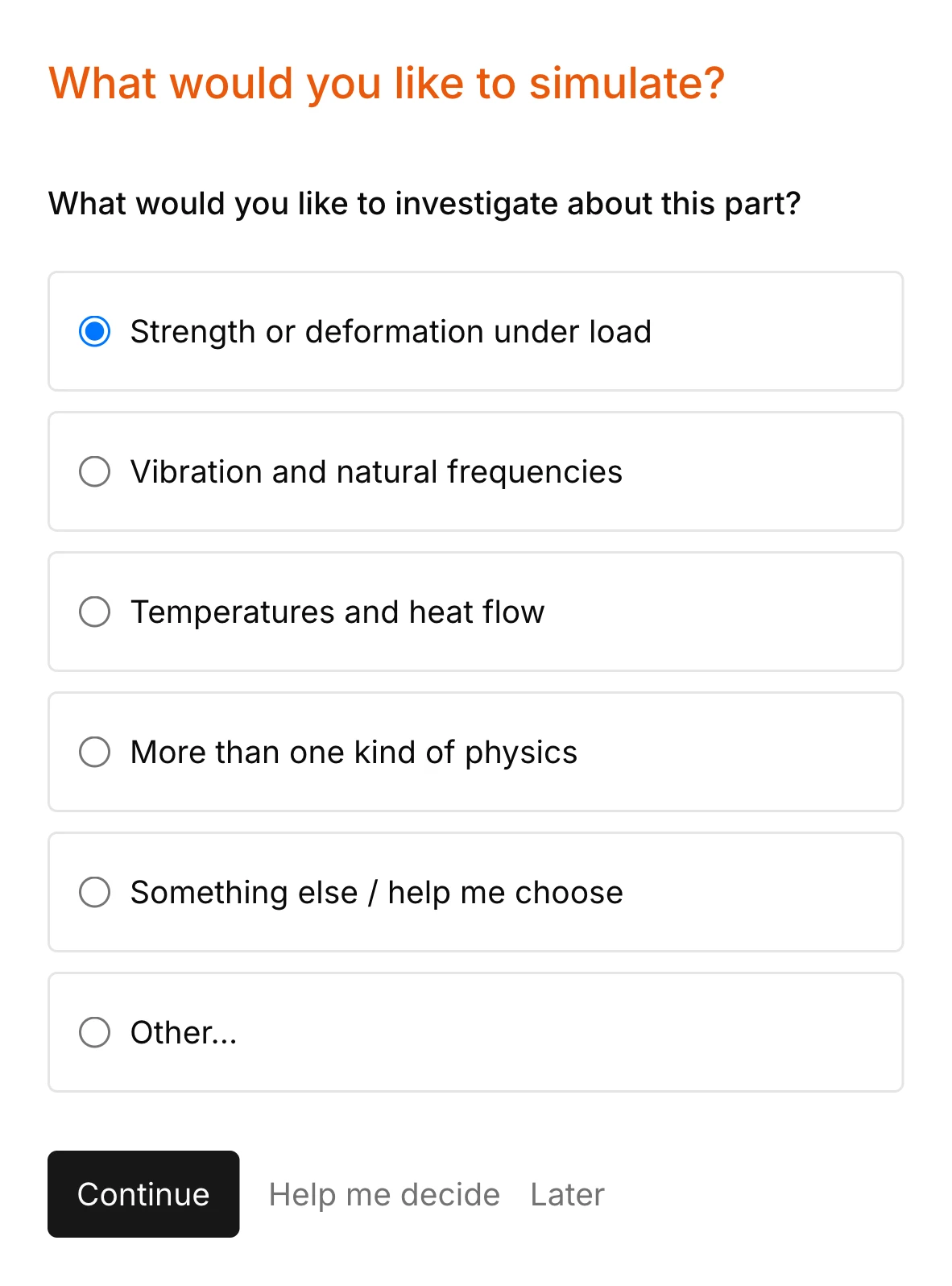
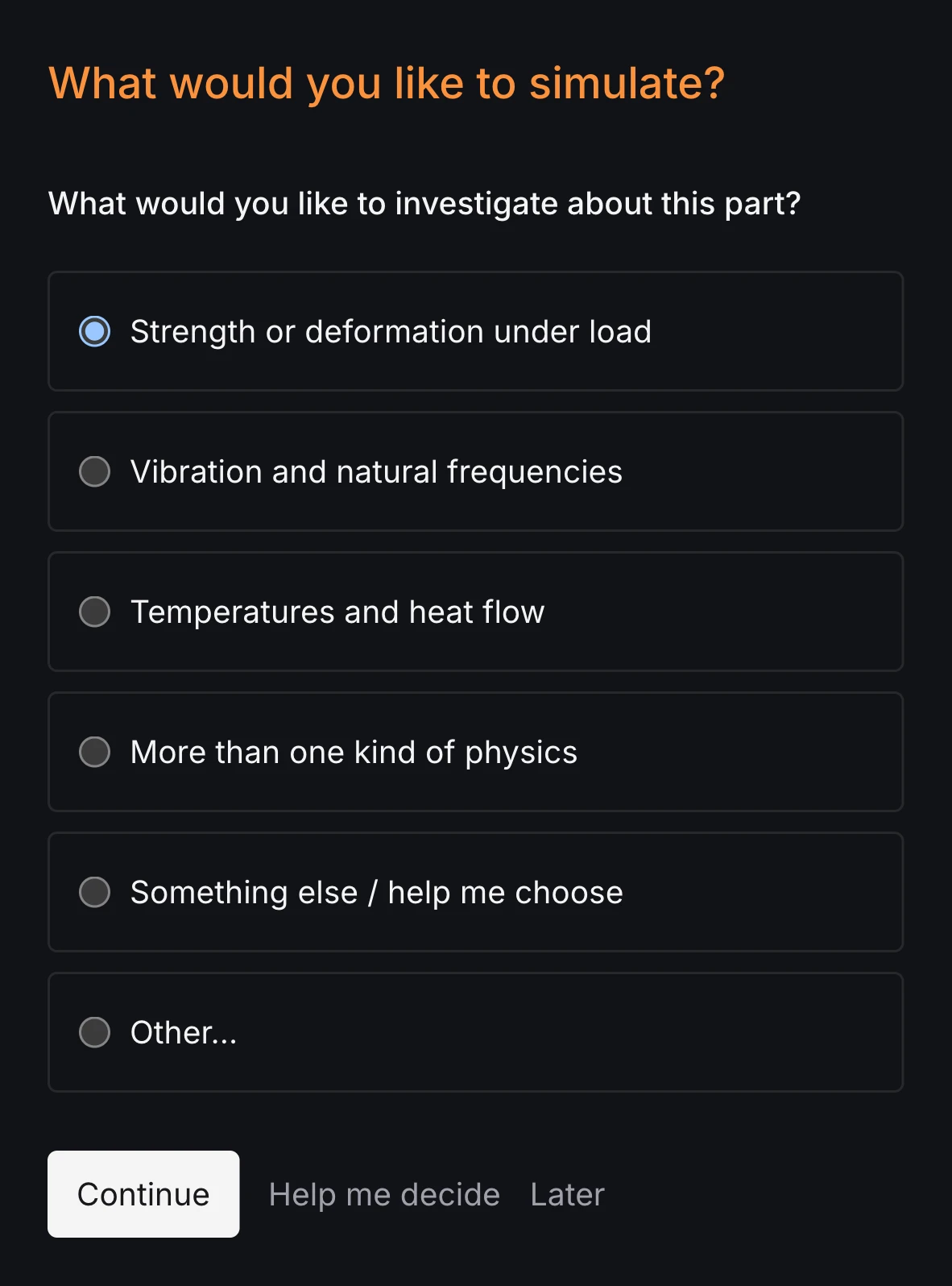
RunMat asks you guided questions to set up the study. It checks for missing inlets, outlets, walls and the rest of the simulation setup, so the study is ready before you run it.
You own the study file: run it, review it and check it into version control. Model anything from laminar flow in a straight pipe to a cooled hydraulic manifold with multiphysics.
Run a simulation across your machines
The same study runs on every core of one computer, or spreads across several machines when the model is large or there are many cases to solve. On Professional, each person's three computers run together as a cluster, and larger clusters run under Enterprise.
RunMat helps you answer flow questions before you machine the part
Does it stay within its pressure-loss budget?
Get the pressure drop between two named ports at rated flow, checked against the loss budget for the circuit and reported passed or failed.
How does the flow divide between branches?
Set the known supply and return conditions, and get the flow through every named port, with the mass balance closed across the ports on every run.
Where does the pressure go?
Follow velocity, pressure and vorticity through the passages to the drilling intersection or bend that costs the most, and read the wall shear stress on every wetted face.
How does the flow respond when a valve opens?
Ramp the supply or step a valve, follow pressure and velocity over time, and get the peak pressure during the transient and the time the flow takes to settle.
The following fluid flow simulation types are supported
Steady flow
Incompressible laminar flow at an operating point, with velocity, pressure and the flow through every named port.
Transient flow
Start-up, supply ramps and valve steps, stepped in time from rest or an initial flow, with any quantity sampled over time.
Pressure drop between ports
The pressure difference from one named port to another at the authored flow, ready to check against a loss budget.
Wall shear stress
Shear on every wetted face, with its time average and oscillatory shear index over a pulsatile cycle.
Heat transfer with flow
Coolant flow and conduction in the solids solved together, with natural convection driven by buoyancy, steady or over time.
Species transport and mixing
Dissolved species and tracers carried and diffused by the flow, with the uniformity of concentration over an outlet.
Porous media
Filters, screens and packed beds as Darcy or Darcy–Forchheimer zones set by permeability, porosity and inertial coefficient.
Non-Newtonian fluids
Shear-thinning and yield-stress fluids such as blood, polymer solutions and slurries, with viscosity set by the shear rate.
Lubrication films
Oil-film pressure in journal bearings from shaft speed and eccentricity ratio, with Elrod cavitation in the divergent film.
Periodic passages
One cell of a repeating channel or fin array, paired face to face by translation or rotation, with a pressure drop across the cell.
Fluid–structure
Flow pressure and shear loading a structure, or a flexible wall and the fluid moving together.
Model fluids, inlets, outlets and walls
Define the fluids, flow conditions and walls of complex cases.
Fluids
- Newtonian liquids and low-speed gases, by density and dynamic viscosity
- Power-law, Carreau, Carreau–Yasuda and Cross fluids
- Bingham, Herschel–Bulkley and Casson yield-stress fluids
- Porous zones: Darcy and Darcy–Forchheimer
- Species carried by the flow, by diffusivity
Inlets and outlets
- Inlet velocity, constant or as a signal over time
- Mass flow on an inlet, in kg/s, with a share per branch
- Outlet pressure
- A pressure reference to set the gauge
Walls
- No-slip walls
- Slip walls and symmetry planes
- Moving walls, with motion as a signal over time
- Periodic pairs by translation or rotation
- Fluid–solid interfaces for heat and structure
Results
- Velocity, pressure, vorticity and face flux
- Wall shear stress on every wetted face
- Pressure drop between named ports
- Mass and momentum balance of every boundary
- Histories sampled over time
RunMat can be used directly by Claude Code, Codex and other MCP clients
Connect RunMat to Claude Code, Codex or another MCP client, and the AI tool you already use sets up and runs the same studies from your CAD file. Its agent writes and edits the .fea study, RunMat checks and solves it, and the results come back to the agent and appear in RunMat Desktop.
FAQ
01Which flows is RunMat built for?
Incompressible laminar flow in and around parts: hydraulic manifolds and valve bodies, cooling channels, microfluidic chips, medical devices, mixers, filters and bearing films. The fluid can be a liquid, or a gas at low speed where its density stays constant, and the flow can be steady or change over time. In a round pipe, laminar flow means a Reynolds number below about 2,300; the manifold on this page runs at about 900.
02Should I set inlet velocity or mass flow?
Set the quantity the system fixes. A pump delivering 20 L/min of ISO VG 46 oil at 861 kg/m³ is a mass flow of 0.287 kg/s on the inlet. Give the outlet a pressure, and don't prescribe both a velocity and a mass flow on the same face.
03How do I know a flow result is right?
Every run checks momentum and continuity cell by cell and reports the mass and momentum balance of every boundary, so the flow into P equals the flow out of A to the study tolerance. Then refine the mesh until the pressure drop stops changing, and compare a straight pipe with the Hagen–Poiseuille pressure drop.
04Can I use a non-Newtonian fluid?
Yes. Power-law, Carreau, Carreau–Yasuda, Cross, Bingham, Herschel–Bulkley and Casson are fluid laws in the material block, each with its own parameters, alongside the Newtonian law.
05Does the flow heat the solids in the same study?
Yes. In a conjugate heat transfer study the fluid and solid regions share their interfaces, heat crosses them in both directions, and buoyancy drives natural convection when gravity is set.
06Do I need a special mesh for the fluid?
No. The fluid is its own body in the CAD file, such as the oil in the manifold's passages, and RunMat meshes it with the solids from one STEP file. Refine near walls where shear matters, and compare two mesh sizes on the value you report.
07Can an AI model write a flow study?
Yes. A study is plain text with units on every value, so an AI coding agent such as Claude Code or Codex can write it from a description of the part, the fluid and its inlets and outlets, and runmat check reports any mistake with its line before anything is meshed.